


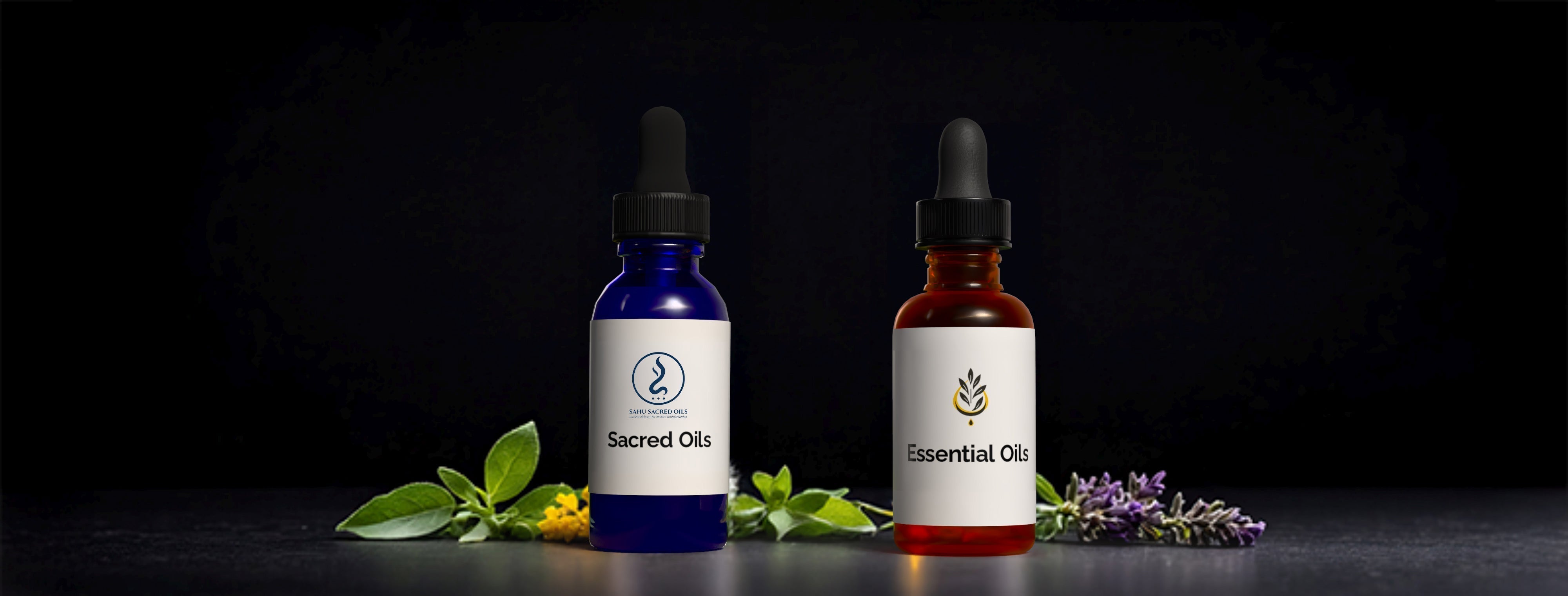
Sacred Oils vs Essential Oils: What Most People Never Learn
In today’s wellness world, the terms sacred oils and essential oils are often used as if they mean the same thing.
They do not.
At first glance, both come from plants. Both carry aroma. Both can become part of ritual, self-care, meditation, or daily life.
But once you begin to explore how they are made, how they feel on the skin, how they unfold in the air, and how people experience them, the distinction becomes much more meaningful.
This is where many people begin to notice that there is more to plant oils than fragrance alone.
At Sahu Sacred® Oils, this difference matters deeply. It is at the heart of why we exist.
What Are Essential Oils?
Essential oils are highly concentrated aromatic extracts taken from plants. In modern production, they are most commonly obtained through steam distillation or hydro-distillation, though some, especially citrus oils, may also be expressed or cold-pressed. These methods are widely used throughout the fragrance, aromatherapy, personal care, and wellness industries.
In a typical steam-distillation process, steam passes through plant material and releases volatile aromatic compounds. Those vapors are then condensed, and the oil is separated from the water. This process is efficient, widely understood, and responsible for much of what the modern world knows as essential oil production.
Essential oils can be beautiful. They can be vivid, sharp, bright, herbaceous, floral, resinous, or energizing. They have earned their place in the modern aromatic world.
But they are not the whole story.
What Are Sacred Oils?
When we speak about sacred oils, we are speaking about something different in both method and philosophy.
At Sahu Sacred® Oils, our offerings are rooted in a traditional Egyptian approach centered on cold pressing, patience, pressure, and lineage. You can learn more about our story on our About page. Rather than relying primarily on heat and vapor to isolate volatile compounds, this approach seeks a fuller botanical expression through a slower, more tactile process. On the Sahu blog and site, these oils are consistently presented as small-batch, cold-pressed oils crafted in Egypt by a seventh-generation family lineage, reflecting a production philosophy grounded in tradition rather than mass industrial standardization.
That difference is not just technical. It changes the experience.
Sacred oils often feel less like a quick burst of aroma and more like a gradual unfolding. Many people describe them as softer, fuller, deeper, and more embodied. Instead of presenting only the brightest aromatic notes first, they may reveal themselves in layers over time.
This is one reason they can feel so distinct from the oils many people have used before.
The Real Difference Is Not Just Scent
Most comparisons between sacred oils and essential oils stop at extraction method.
That is useful, but incomplete.
The deeper difference often shows up in three ways: composition, character, and experience.
1. Composition
Steam distillation is especially associated with collecting the plant’s volatile aromatic compounds, the components that rise with steam and carry scent. Cold pressing, by contrast, can preserve a somewhat different profile depending on the plant, including heavier fractions that do not behave the same way under distillation. Research on cold-pressed versus distilled citrus oils shows that extraction method can significantly influence chemical composition, including non-volatile fractions.
This matters because the method shapes what is ultimately present in the finished oil.
So when someone says two oils are “the same plant,” that does not necessarily mean they are the same experience.
2. Character
Essential oils often have a more immediately recognizable aromatic signature. They can be vivid, penetrating, and direct.
Sacred oils, especially those made through traditional cold pressing, often feel rounder and more dimensional. Some people even describe them as perfume-like, not in the synthetic sense, but in the way they develop slowly and continue changing on the skin.
It is less like a flash, more like a conversation.
3. Experience
This is the part that is hardest to quantify, and often the part people remember most.
There is a difference between smelling something and feeling as though you are entering a relationship with it. For example, oils like Blue Lotus have historically been used in meditation and ceremonial practices for their unique aromatic depth.
That may sound poetic, but anyone who has had a powerful experience with a plant aroma knows exactly what this means.
Sometimes the shift is immediate. Sometimes it is subtle. Sometimes you do not fully understand it until later.
You simply notice that the experience stayed with you.
Why Egyptian Sacred Oils Feel So Different
This question sits at the center of Sahu.
Why do these oils feel different to so many people?
Part of the answer lies in tradition.
Sahu’s oils are tied to an Egyptian family lineage and a slower method of preparation that stands apart from industrial aroma production. On the Sahu site, the oils are described as cold-pressed in Egypt by a seventh-generation family lineage, and the broader brand language emphasizes sacred intention, small-batch craftsmanship, and ancient alchemical roots.
Part of the answer lies in process.
Modern wellness culture often moves fast. Scale, efficiency, output, consistency, and margins tend to lead the conversation. Traditional sacred oil making points in another direction. It values time, care, and the preservation of a more complete botanical character.
And part of the answer may lie in context.
When a plant is approached not just as raw material, but as something worthy of reverence, the entire relationship changes.
That does not mean every person will describe the experience the same way.
It does mean that many people sense, quite quickly, that they are not dealing with a generic product.
Why This Difference Matters Today
We live in a time when many people are craving depth.
Not more noise.
Not more speed.
Not more products that all say the same thing.
They want something real.
Something with a story.
Something made with care.
Something they can feel.
This is one reason interest in sacred oils continues to grow. Not because they are trendy, but because they answer a deeper hunger.
They invite people into a slower experience.
A more intentional one.
A more relational one.
For some, that looks like meditation.
For others, it looks like prayer, breathwork, journaling, rest, beauty ritual, or simply taking one conscious pause in the middle of a busy day.
The point is not to force a dramatic meaning onto the moment.
The point is to create space for one.
How to Choose Between Sacred Oils and Essential Oils
This does not need to be an either-or debate.
There are many people who appreciate both.
But it helps to know what you are looking for.
You may prefer essential oils if you want:
- a familiar aromatic format
- strong immediate scent projection
- widely available plant profiles
- a standard modern category used across many industries
You may be drawn to sacred oils if you want:
- a more layered and nuanced aromatic experience
- a traditional, lineage-based approach
- a slower, more intentional relationship with plant essences
- oils that feel less purely functional, and more ceremonial or experiential
In other words, one path is often about aroma as product.
The other may feel more like aroma as presence.
For a deeper example of how this difference shows up in a specific oil, see our guide on Blue Lotus and how it compares to essential oil versions.
What Most People Never Learn
Most people never learn that the method matters.
Most people never learn that two oils from the same plant can feel entirely different depending on how they were made.
Most people never learn that some oils were never meant to be reduced to scent alone.
And most people never learn that there are still traditions in the world protecting a more ancient relationship with plants, pressure, patience, ritual, and time.
That is part of what sacred oils preserve.
Not just aroma.
A way of relating.
The Sahu Perspective
At Sahu Sacred® Oils, we are here to help people rediscover that relationship.
Our work is not built on speed, hype, or imitation. It is built on reverence for rare Egyptian sacred oils, on honoring a traditional family lineage, and on offering oils that invite depth, presence, and transformation through daily ritual. Sahu’s own blog positioning emphasizes that these oils are distinct from standard essential oils and are rooted in ancient alchemy, spiritual intention, and small-batch Egyptian craftsmanship.
For some people, the difference is noticeable the first time they open a bottle.
For others, it arrives later.
In a quiet moment.
In a meditation.
In a memory.
In the simple realization that what they are experiencing feels fuller than what they expected.
Not everything meaningful announces itself loudly.
Some things reveal themselves slowly.
And once you experience that difference, it is hard to forget.
Explore Sacred Oils for Yourself
If you have only experienced standard essential oils, sacred oils may open an entirely new doorway into the world of plant aroma and ritual.
Not because they are louder.
Because they are deeper.
Explore our collection of pure Egyptian sacred oils to experience the depth and character of traditionally crafted oils.
Need help?
Frequently Asked Questions
Read more
Sacred Oils That Help Activate the Root Chakra for Stability and Grounding
When life feels uncertain, many people experience restlessness, anxiety, or disconnection. Spiritual traditions often link these feelings to an imbalanced Root Chakra, the energy center connected w...
Read Full Article
Why Egyptian Blue Lotus Is Different (And Why Most Blue Lotus Isn’t the Same)
Blue Lotus has been showing up everywhere lately. You’ll see it described as rare, ancient, even mystical. And in some ways, that’s true. But there’s something most people don’t realize when they f...
Read Full Article
Stay Aligned
Join the Sahu Journey
Be the first to receive sacred insights, exclusive offers, and guidance on transformation. Sign up to elevate your path with Sahu Sacred® Oils.