

Article: Why Sacred Oils Smell Different Than Essential Oils

Why Sacred Oils Smell Different Than Essential Oils
A deeper look at scent, soil, harvest, maceration, cold pressing, and the living expression of the plant
Most people expect oils to smell a certain way.
If they have used essential oils for years, they usually expect something sharp, immediate, and familiar. Lavender should smell like lavender. Peppermint should smell like peppermint. Rose should smell like rose.
Then they open a bottle of Sahu Sacred® Oils and something feels different.
The scent may be deeper. Softer. More layered. Sometimes richer. Sometimes more perfume-like. Sometimes it takes a few moments to fully open.
And that often leads to the question:
Why do sacred oils smell so different than essential oils?
The answer is not one thing.
It is the plant.
The soil.
The sun.
The water.
The harvest.
The method.
The carrier oil.
The aging.
The intention.
And the philosophy behind the entire process.
Sacred oils are not simply essential oils with a spiritual name.
They are a different category of aromatic botanical essence.
Essential Oils Are Usually Built Around Volatility
Most modern essential oils are produced through steam distillation.
Steam passes through plant material, captures volatile aromatic compounds, then condenses them into oil. This process is efficient, scalable, and widely used throughout the aromatherapy industry.
It is also why many essential oils smell bright, quick, and direct.
They are often centered around the plant’s volatile aromatic molecules, the lighter compounds that rise with steam.
That can be beautiful.
But it is not the only way to experience a plant.
Sacred oils, especially the traditional Egyptian oils, come from a broader process. They are not only about what rises quickly. They are about what can be drawn out slowly.
Sacred Oils Are Slower by Nature
The sacred oils, from the family, are created through a layered process that combines maceration, cold pressing, handcrafted carrier oils, resting, filtering, and aging.
Maceration means plant material is steeped in some oil so the carrier can slowly absorb parts of the plant’s aroma, color, texture, and character. Cold pressing then uses pressure instead of steam to help bring more of the plant expression forward.
This is one of the biggest reasons sacred oils can smell so different.
They are not only capturing the most volatile parts of the plant.
They are carrying something fuller.
A sacred oil may include aromatic notes that feel deeper, rounder, heavier, softer, or more grounded than a standard steam-distilled essential oil.
That is not a flaw.
That is the point.
Why the Process Matters
One of the biggest misconceptions people have is that oils are made in a single step.
That isn't what happens here.
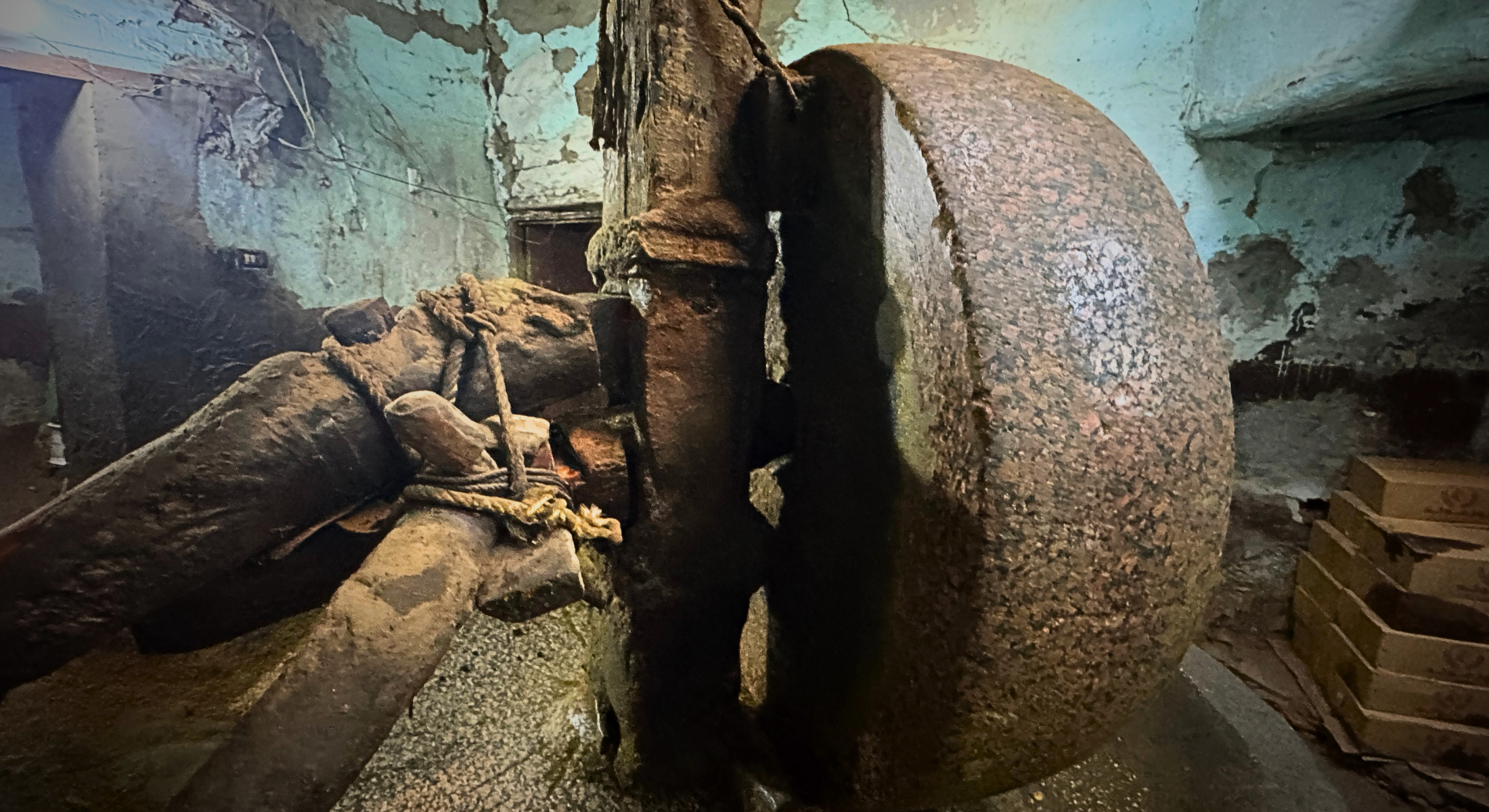
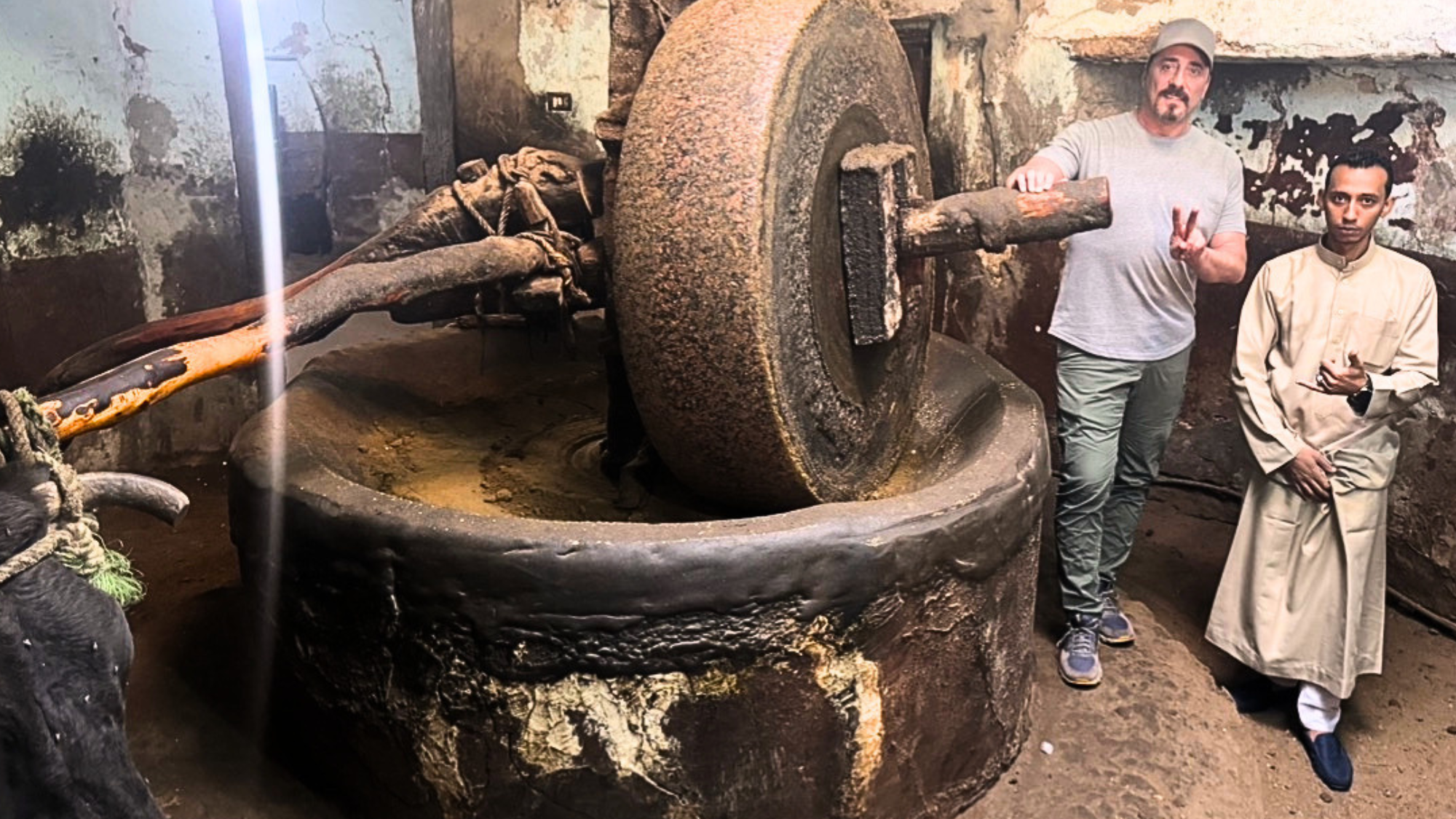
After the plants have been selected and prepared, they are slowly macerated before moving beneath a granite wheel weighing approximately 2,200 pounds.
A sacred Apis bull patiently walks in circles for hours, sometimes as long as six hours, turning the wheel with steady pressure instead of heat. See the first FAQ as I was concerned about the bull's treatment.
The result is not yet the finished oil.
What remains is a dense botanical mash.
That mash is carefully collected and packed by hand into thick woven natural fiber discs (the family calls them porsches) that resemble large herbal cakes.
These cakes are then stacked inside a traditional screw press.
Slowly, tremendous pressure is applied.
Not seconds.
Not minutes.
Sometimes hours.
Additional oil continues to emerge from the botanical material.
The freshly expressed oil is collected, filtered, and later transferred into oak barrels (natural preservation) where it continues to mature before bottling.
Every one of those steps changes the final aromatic profile.
The scent is not created by one moment.
It is built layer by layer through time.
That is one reason sacred oils often feel richer, rounder, and more complete than oils produced through faster industrial extraction methods.
The Scent Comes From the Whole Journey
When I visited Egypt in December 2025, I spent the day with the family and saw the process firsthand.
I walked the bull during the pressing of rosemary. I stood next to the granite wheel. I watched the plant material being worked slowly, not rushed.
What stayed with me was how alive the process felt.
It was not manufacturing.
It was relationship.
The family has explained that the plant itself matters deeply, including the soil, the climate, the water, the timing of harvest, and the condition of the plant when it arrives at the press. In his words, the plant is a living being, and the oil carries the true essence of that plant.
That is why two batches may not smell exactly the same.
The plant is never exactly the same.
Each Batch Is an Expression of the Harvest
In commercial production, consistency is often the goal.
That makes sense. Large companies need the same aroma, color, and profile again and again.
But traditional sacred oils are closer to a living craft.
A batch reflects the season it came from.
The sun may be stronger one year.
The harvest may happen earlier or later.
The plant may be drier or fresher.
The soil may hold different moisture.
The flowers may open differently.
The oil may deepen differently in aging.
The family has said this clearly with the blue lotus, explaining that lotus oil depends on the plant, that colors can vary naturally, and that harvest timing changes because weather affects the flower and the amount of oil produced.
That is important.
Because it means sacred oils are not engineered into sameness.
They are guided into expression.
Why the Aroma Can Feel More Perfume-Like
Some people describe Sahu Sacred® Oils as perfume-like.
I understand why.
They can feel layered, rounded, and long-lasting on the skin.
But they are not commercial perfumes.
There is no alcohol.
There is no standard perfume base.
There is no conventional perfume fixative structure.
The family has described the family’s oils as sacred therapeutic aromatic oils, distinct from commercial perfume. He explained that their carrier oils, with 2-3 added proprietary industry ingredients (secret family recipe) help bind and soften the oils, reveal the beauty of each type, extend the fragrance, and support shelf life. The total carrier oil and 2-3 ingredients do not make up more than 5-6% of the sacred oil created. Oftentimes it's less than 4% as it differs based on the oil they are crafting. The family also adds secret family recipe natural colors at times. I honor and respect that they do not feel comfortable sharing their methods & formulas.
That is a major difference.
A steam-distilled essential oil often flashes quickly.
A sacred aromatic oil may unfold slowly.
It may sit closer to the skin.
It may change over time.
It may reveal different notes as it warms.
It may feel more like an atmosphere than a single scent.
That is why people sometimes struggle to describe it.
They are not just smelling an oil.
They are experiencing an aromatic composition created through plant, oil, pressure, time, and tradition.
Egypt Changes the Oil
Place matters.
This is something I keep coming back to.
An oil made in Egypt is not only shaped by the plant species. It is shaped by the land itself.
The Nile (at times).
The climate.
The soil.
The heat.
The dryness.
The timing of harvest.
The hands that pick the plant.
The prayers said before the work begins.
The family described the plants as growing in a cleaner climate, away from crowded cities, dust, pesticides, car exhaust, and factories, watered by the Nile River, and handled by people working with sincere intention. If the plant is not grown on their farm, they support local & regional farmers. They also work with the same family (for many generations) when importing seeds and plant parts that are not conducive to growing in the region.
That may sound poetic, but from an agricultural standpoint, it also makes practical sense.
Plants are shaped by environment. Soil, climate, cultivation method, harvest time, and growing conditions can all influence aromatic composition and oil yield. Research on aromatic plants consistently shows that environmental and cultivation factors can affect essential oil content and chemical profile.
So when we say Egyptian sacred oils smell different, we are not only speaking spiritually.
We are also speaking botanically.
Ancient Egypt Had a Different Relationship With Aroma
Modern people often think of oils as products.
Ancient cultures often treated aroma as ceremony.
Egyptians were known for working with aromatic plants, resins, oils, and fats in ways that included maceration, enfleurage, pressing, and perfume-making. Historical sources describe ancient Egyptian perfume traditions as deeply tied to temples, offerings, ritual, beauty, and sacred life.
That matters because Sahu Sacred® Oils is not trying to imitate the modern essential oil industry.
We are honoring a much older relationship with scent.
A relationship where aroma was not separate from spirit, body, memory, and devotion.

The Role of Prayer and Intention
This is one of the most meaningful parts of the process.
The family is Muslim. Prayer is part of daily life.
The family explained that before harvesting, they wash and pray. The harvest is done in the morning after Fajr prayer. Later, before placing the plants inside the granite stone, they wash and pray again. During extraction, they continue praying, and a small radio in the press plays Quran recitation while the work is taking place.
Whether someone shares that religious framework or not, it is impossible to ignore the depth of care behind the process.
The work is not casual.
It is intentional.
And that intention is part of why the oils feel different.
They are made slowly, with attention, prayer, and a sincere hope that the oils support those who use them.
Sacred Oils Are Living Oils
This may be the most important distinction.
The family believes the plant is a living being, and the oil extracted from it is also a living oil. He describes the oil as carrying the true essence of a real plant grown in real soil by human hands with pure hearts.
That belief changes everything.
If you see oil as a commodity, you make it one way.
If you see oil as a living expression of plant, place, and prayer, you make it differently.
That is why sacred oils do not feel like factory-made fragrance.
They feel more personal.
More relational.
More alive.
Why Color Can Vary Too
Scent is not the only thing that can vary.
Color can shift as well.
This is especially true with delicate botanicals like lotus. The family has explained that lotus oil depends on the plant itself, that sometimes the flower does not need any natural color adjustment, and that sometimes natural plant-based color support may be used depending on the flower and desired result. He also emphasized that manufactured powder is not used.
This is another reason sacred oils do not always behave like standardized commercial products.
Color, scent, texture, and depth can all reflect the plant’s condition and the process used to bring it forward.
That is part of the living nature of the craft.
Why This Can Confuse People
If someone is used to standard essential oils, sacred oils can challenge their expectations.
They may wonder:
Why is this softer?
Why is it richer?
Why does it last longer?
Why does it smell more layered?
Why does it vary slightly from batch to batch?
Why does it feel more like an aromatic elixir than a typical essential oil?
Those are fair questions.
And the answer is simple:
Because it is not made the same way.
A sacred oil is not just a distilled scent.
It is a combination of plant material, carrier oil, maceration, pressing, aging, land, harvest, and intention.
It is closer to a handmade family recipe than a standardized industrial product.
The Homemade Sauce Comparison
The best way I can explain it is this.
A commercial pasta sauce is designed to taste the same every time.
My grandmother Nunciato’s homemade red sauce was different.
It was made by feel. By taste. By memory. By intuition. The tomatoes changed. The herbs changed. The mood in the kitchen changed. Nothing was measured with industrial precision.
But that was the magic.
It was alive because someone was present with it.
That is how I understand these sacred oils.
They are not random.
They are not careless.
They are refined through experience.
But they are not forced into sameness.
Each batch carries the fullest expression of the plant, the harvest, the climate, the family’s method, and the moment it was made.
A Different Category Altogether
This is why I believe sacred oils deserve their own category.
They are not standard essential oils.
They are not commercial perfumes.
They are not fragrance oils.
They are sacred aromatic oils, botanical essences created through traditional methods, living plant intelligence, and intentional craftsmanship.
They exist somewhere between aroma, ritual, skincare, meditation, heritage craft, and personal experience.
And maybe that is why people feel them before they fully understand them.
Why This Matters for Sahu Sacred® Oils
At Sahu Sacred® Oils, my goal is not to make these oils fit into a category they were never meant to belong to.
My goal is to help people understand the category more clearly.
Sacred oils are different because they come from a different worldview.
A worldview where the plant matters.
The soil matters.
The sun matters.
The water matters.
The harvest matters.
The person making the oil matters.
The prayer matters.
The process matters.
And when all of that comes together, the scent carries more than aroma.
It carries story.
It carries place.
It carries presence.
That is why sacred oils smell different.
And that is why the difference matters.
Explore Egyptian Sacred Oils
If you are curious to experience this difference for yourself, explore our collection of Egyptian sacred oils and botanical essences, crafted through traditional methods and created to support presence, ritual, and a deeper relationship with the plant world.
Read more
How Cold-Pressed Sacred Oils Are Made (And Why It Changes Everything)
Most people have never seen how oils were traditionally made. Today, the vast majority of oils on the market are produced through modern industrial methods designed around speed, consistency, and s...
Read Full Article
Stay Aligned
Join the Sahu Journey
Be the first to receive sacred insights, exclusive offers, and guidance on transformation. Sign up to elevate your path with Sahu Sacred® Oils.